

The pact is the Mecca Joint Defense Agreement, signed on August 7, 2026, in Mecca by Saudi Crown Prince Mohammed bin Salman, Turkish President Recep Tayyip Erdogan, and Pakistani Prime Minister Shehbaz Sharif. The public text is thin. The full agreement has not been released.
What it says
A joint statement says the deal is meant to strengthen collective deterrence and that “any armed attack against any one of the three states shall be regarded as an attack against them all.” It also calls for broader defense cooperation. A Turkish official told Reuters it is “purely defensive.” Saudi officials said it is not a new military axis, a sectarian bloc, or an arms race, and that it is open to other countries. Erdogan said implementation could include joint defense-industry projects and counterterrorism work. There are no published rules on automatic troop deployments, command structure, or nuclear sharing.
It extends a Saudi–Pakistan Strategic Mutual Defense Agreement signed in September 2025. That bilateral deal used similar “attack on one is an attack on both” language, and some officials then hinted at extended nuclear deterrence. That nuclear claim is not in the recent public trilateral statement.
Why it was signed
It followed nearly a year of talks and was driven by the U.S.–Israel war with Iran that began on February 28, 2026, Iranian missile and drone strikes on Gulf states, and renewed Houthi attacks on Saudi territory and Red Sea shipping. Gulf governments have been hedging because they no longer treat the U.S. security umbrella as enough on its own. The three capitals say the pact supplements U.S. ties, not replaces them. Turkey is in NATO; Saudi Arabia and Pakistan are long-standing U.S. partners.
What each side brings
Saudi Arabia: money, geography, oil, and political weight in the Gulf. It has had a GCC mutual-defense clause since 2000 and the 2025 pact with Pakistan.
Turkey: NATO’s second-largest military and a growing defense industry (drones, munitions, joint production). Analysts at RUSI see procurement and interoperability as Ankara’s main payoff. Some also read it as extra deterrence toward Israel.
Pakistan: a large, experienced army, decades of troop deployments in the kingdom, and the only Muslim-majority nuclear arsenal. Islamabad wants steadier Saudi financing, a counterweight in its rivalry with India, and less dependence on China.
Recep The Conquerer – Turkey Dreams Of Becoming A New Ottoman Empire
·
"You weep for the dead in Ukraine, why don't you speak out in defense of these babies killed in Gaza? Oh, West, I cry out to you, do you want to start your crusade against the Crescent again? If you are making such efforts, know that this nation is not dead."

How analysts read it
The Atlantic Council’s expert roundup treats it as real but not NATO-like. Riyadh’s earlier mutual-defense deals have not produced Article 5-style responses. The value is leverage and uncertainty for adversaries, not a fixed war plan. Al Jazeera’s analysis says the unnamed adversary is mainly Iran and its network (Houthis, Iraqi militias, Hezbollah), but none of the three is ready for an open fight with Tehran. Pakistan has historically avoided direct conflict with Iran even after attacks on Saudi Arabia. Dawn argued it institutionalizes planning, intelligence, training, and interoperability while leaving the decision to use force with each capital. The New Arab called it the start of a more regionally owned security order, built on two earlier bilateral tracks.
What has happened since
It has moved past a photo-op. On September 19, Turkey said it was ready to meet Saudi military needs under the pact. On September 23, Pakistan named the first secretary-general of the arrangement. On September 25, the three foreign ministers met on the sidelines of the UN General Assembly, reviewed institutional progress, and called for an urgent meeting of military chiefs. Asia Times reported tentative joint planning against Houthi strikes on Saudi territory and Red Sea infrastructure, alongside a separate maritime effort.
Bottom line
It is a political mutual-defense commitment among three capable Sunni-majority states, aimed at deterring Iran and its proxies and at reducing sole reliance on Washington, without a published operational trigger or nuclear clause. Whether it works will depend on whether the new secretariat and ‘military chiefs channel’ produce real air defense, intelligence sharing, and industrial cooperation when the next strike hits — not on the Article 5-style wording.
Main analyses: Atlantic Council, Al Jazeera, The New Arab, Dawn, Asia Times on the first operational steps. News accounts: Reuters, BBC, AP, New York Times.
“Article 5-style wording” means the pact copies the political formula of NATO’s mutual-defense clause, without copying the machinery that makes that clause work.
Another Step Closer To World War III
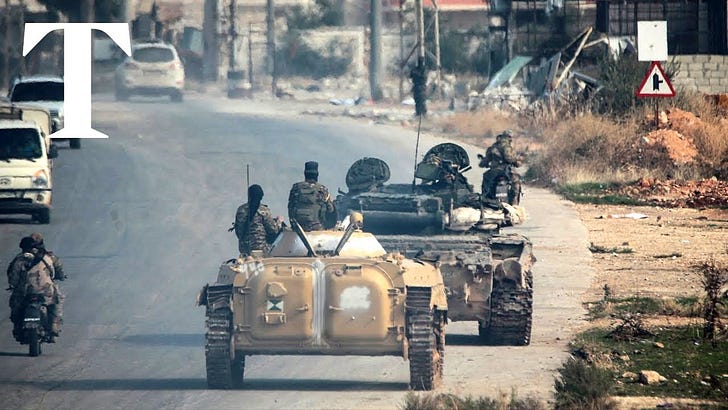
Chaos begets chaos. Instability leads to more instability. For almost four years now we have lived with an administration in Washington that has done its best to upset the international order and break down alliances that took us 75 years to build. The consequences are appearing everywhere, most recently in Syria.
What a nice surprise to see AND Magazine post in my inbox Missing Sam and still in disbelief at the quickness of events. Sam, you are missed and my heartfelt sympathies for those you left behind. the world is still spinning!